
Giuseppe Dal Prá (Founder & CEO of the Odyssean Institute and writer of treatises on altered states for civilisational reform) was sent as a correspondent for QRI to probe what people at Breaking Convention were thinking vis-à-vis mathematical and structural approaches to psychedelic phenomenology.
This Breaking Convention (BC) was the second edition I had the pleasure of attending; my first, in 2019, I attended while concussed and sleep deprived. This owed to an Amsterdamaging trip to the Katharsis industrial techno party that saw me face planting concrete. One dashing forehead scar later, and I was in a half space of sanity at Greenwich’s Dreadnought Court. I was unable to take in as much of that BC due to being so frazzled. This time, although recovering from my most serious cold of the year, I was able to absorb more. Moreover, I did so with an agenda: to write this piece for all of you wonderful readers.
BC is a multidisciplinary psychedelics conference, bringing findings and insights from across still burgeoning psychedelic studies. It dates back to an inaugural edition in 2011 at the University of Kent, and has grown from strength to strength much as the psychedelic Renaissance’s own breadth, exposure, and momentum has alongside it. You can expect to hear from fields as diverse as neuroscience, pharmacology, anthropology, theology, investigative journalism, and philosophy… 2025 was no different.
My expectations were high, seeing as I knew a good number of researchers and could count many as dear friends. However, the scope of the conference was much larger than any social network I was in could overlap with. My expectations were exceeded overall, with the quality and breadth of programming giving plentiful activity throughout and much to absorb and think about. With a remit to both think about what I saw with reference to QRI, and interview a number of presenting professionals, it was a rather breathless occasion. Moreover, it was a very worthy one.
Some very minor areas of improvement would likely be the price, which was not unusual for conferences, but to combat any risk of psychedelic science being an elite practice, accessibility of this kind is vital (perhaps more widely available forms of concession ticket could be considered next year). Additionally, access to lecture recordings when the events were still fresh would have been very helpful; uploads coming months later, for those writing on the proceedings, complicated catching up, especially for those encumbered by recovering from illness (as I was). I’m enthused to say the talks are now available at Breaking Convention’s YouTube Channel.
Thursday, 17th April
The Thursday opening was delivered by Mac McCartney, who stood out with his choice of a wonderful DH Lawrence quote redolent of Bergson and Whitehead’s beatific process views: ‘I am the sun as my eye is part of me. That I am part of the earth, my feet know perfectly, and my blood is part of the sea.’ This distributed view, which one might connect to multiagent consciousness, of the mind intimately manifesting through solar light, oceanic water, and earthly touch, extends the parameters of valence out into the cosmos through an elemental framing. It was the right image to begin a journey of ideas with.
Kat Harrison followed this up nicely with hydrological metaphors describing the slipstreams of the underground, a fitting image to settle everyone into the myriad flows and becomings BC would potentiate. A particularly intriguing section saw her discuss defining luck — O Fortuna herself — where the cybernetic interplay of being awake and aware of myriad information around you is so key. If one is receptive, embodying the yin, perhaps opportunity scanning feels revelatory or heaven-sent; when one is more yang, the thrill of the chase and the initiatory agency perhaps come more to the fore. Both up and downswings of perception enable one to plug into copious synchronicities, or at least their precursors.
Next up I had the pleasure of witnessing talks from Matthew Segall and Peter Sjöstedt-Hughes. As usual an exploration of metaphysics writ more phenomenal through psychedelia, and in Peter’s case with inspection of the overlaps in cosmic consciousness, pantheism, and animism, was fascinating. Segall’s talk on process philosophy was always a welcome addition. Whitehead’s metaphysics remain perhaps some of the most recognisably ‘elevated’ modes of metaphysical enquiry, for its holistic and lively nature, and for synthesising such grand scales with experience itself as grounding.
Alas, my energy levels had reached an ebb on this day, so Friday and Saturday were where proceedings really ramped up. However I was able to attend Naina Eira and Robert Koch’s guided Tantric meditation, which was a wonderful way to both relax and absorb minimal tones in a type of gong bath. Having experienced a guided meditation by Naina before for the Exeter Psychedelic Colloquium, I knew to expect an expertly delivered tantric meditation, and I was not disappointed. A truly delightful close to the first day.
Friday, 18th April
Friday began for me with Samuli Kangaslampi’s session covering tripping and memory. The possibility of less experienced trippers facing down false memories, perhaps born from the annealing of content without entrained, restabilising focus, reared its head as a crucial consideration. Views of tripping as an inhibiting of the brain’s natural filtration don’t mean everything that passes through the filter is worth holding equally valid; enabling us to potentially dissolve some of the riskiest negative valences preemptively, or with good spotting of knotted thoughts we may encounter. We have our wits about when sober for a reason, even if flights of fancy can give us new landings of health.
Anne Mathie’s session on Theravada and associated concepts from Jainism, leading into an analysis of the Jhanas, was extremely interesting. Jainism has always struck me as vital for any efforts to widen the moral circle — something expanded consciousness often achieves, through building on the ruined normality you are left with after sufficiently strong experiences of groundlessness and boundlessness (as excavated in Eirini Ketzitzidou-Argyri’s work). The Jhanas, as exercises in radical self-emptying, until the very foundational co-arises from nothingness, are an extremely relevant limit experience when pursuing ‘bliss engineering’. As part of a well-established wisdom tradition, their experimentally derivable nature makes them especially helpful for involuting these expanded moral circles into one’s inner horizons. This, as a fractal instantiation of widened compassion not only for others through metta, but also for oneself.
Pascal Michael’s UFO session was extremely intriguing: the typology of experiences between NDEs, psychedelics, and UAPs being the focus. The challenge of cleanly separating these experience categories without either overclaiming or dismissing the phenomenological overlap is genuinely difficult, and Pascal navigated it with considerable care. Although conspirituality was rightly brought up, a reality of classified smoke and mirrors around the ‘nuts and bolts’ of this phenomena was beyond the scope of the talk. Nevertheless it would be welcome if future academic work were able, albeit naturally against great pressure, to see where the material and phenomenology intersect. This may risk turning rabbit holes into rhizomatic warrens; but such is the dogged pursuit of truth. Some questions about context and the limits of purely academic framing were reserved for the Q&A.
Tom O’Neill’s talk ended up being a surprise highlight of BC, presenting investigative journalism of the highest calibre. The morbidity of the subject matter was the height of wrestling with negative valence. Tom’s excellent work revealed the connections between MKUltra’s Dr Jolyon West and Charles Manson; he was his parole doctor. Such a connection and Charles’ inexplicably repeated paroles despite constant infringements (with guns, drugs, and girls discovered on his compound) reveal that the Manson murders appear a classic case of intelligence agency chicanery: rake the weapons of counterculture and train them on a strategy of tension, as done through Operation GLADIO and Cointelpro.
Similar perhaps to the infractions and constant permissiveness shown to Jim Jones, their freedom for the purposes of breaking possible class solidarities and redirecting them towards more malleable sectarian conflicts or cult dynamics, is apparent. This was a drop of needed (anti)venom in a space that might sometimes risk coming off Panglossian in the relatively more accessible phenomenological gains individual ‘enlightenment’ can produce. The insights dating back to MKUltra remain unsettlingly relevant to the present; with grift, psyop, and social media scaling these to head spinning degrees, and the recollection of Timothy Leary that the CIA introduced LSD into the mainstream, the intersections of cultic, psychedelic, and social control are examples of a world increasingly seemingly Gnostic in political economy.
The evening’s festivities concluded with a delightfully whimsical cabaret and comedy; including the presence of CatGPT, a feline AI with bags of sass. Comic relief was certainly needed after the noided crescendo of the day, and the shows handsomely delivered. It also provided balance to the screening of Wetiko, an intriguing horror about the use and abuse of indigenous knowledge by gringo shamans in Mexico.

Saturday, 19th April
On Saturday I attended a press Q&A, where I asked Bruce Damer about the role of entities and possible concomitant information processing augmentations on scientific innovation, since he had experience with Ayahuasca that he covered in his later talk. His answer was admittedly to a curveball question. He invoked Silicon Valley and LLMs as examples of psychedelically-adjacent creative augmentation. While strictly true, the present and developing abuses of Silicon Valley and potentially AI in surveillance did, as with O’Neill’s talk earlier in the conference, highlight by their absence a critique of the danger of techno-solutionism and innovation for its own sake. His talk proper was far more extensive, covering Ayahuasca’s role in his theorising about the emergence of life; a direct corollary of the sort of findings that Peter Sjöstedt-Hughes’ and Danny Nemu’s writings on Eleusis and its role in birthing the Western philosophical tradition also belie.
Alex Beiner’s talk centred on 4Es cognition and the enactive, embodied dimensions of psychedelic states entered genuinely interesting territory. A claim that psychedelics usher in a post-ideological age seemed however to subvert the potential of his message. The claim to being post-ideological — something even Slavoj Zizek, a man constantly battling what seems to be post-nasal drip — recognises as specious raised questions about the realism or indeed the ambition of change that psychedelic visions can impart, if they don’t come with a trenchant acknowledgement of the ‘laundry after the ecstasy’, or, engaging with a political world of ideas, values, and biases. When an ideology of might is right (in the very first year of Trump II) continues to drive political and ecological collapse through the West and into the global, a post-ideological framing felt dangerously naive.
Consider the fascinating evidence from Dave Troy that the KGB utilised meditation schools in the United States as a deliberate means of demoralising the American public, in effect encouraging a ‘post-ideological’ inert navel gazing that would allow American class dynamics to further degrade rather than awaken. Ironically this mirrors the CIA’s mesmeric Praetorianism touched on above; the Cold Warriors in agreement that post-ideology was a route to apathy, to be engineered with spiritual bypassing. Ideology might seem passé to the ‘enlightened’ but the chopping of wood and carrying of water persists; and the War on Drugs has users to feed the prison industrial complex (for coerced carrying of water) that is very real, and very political, in operation. Nevertheless, in general his talk offered substantive framing for what psychedelics do to the situated, embodied mind.
Jamie Wheal on the other hand pulled no punches, mixing the intensity of a truly ambitious futurist with a well-needed polemic against the conceited capital of Compass, aiming to corner psychedelia with patents. It was the kind of galvanising attack at the jugular of Peter Thiel, a man who reminded us through his tangled web of influence and conspiring democracy, that metaphysics are part of this. His invocation of the Antichrist against Greta Thunberg was singled out for justified polemic; its Orwellian absurdity showing that who funds what work is not incidental, but may reveal strategies within mainstreaming psychedelia that subvert their liberatory or developmental potential. It was delivered with a very welcome urgency befitting of the moment.
Interspersed before these keynotes and after, I went to see Vincent Moon’s cinematic VJing, which was a majestic inclusion to BC 2025. His cinematic mixing of footage taken around the world was a perfect multimedia complement to the cerebral schedule of scientific findings. To be immersed in such a myriad of artistic expressions, musically and visually, was a perfect conclusion to the conference’s daytime activities.
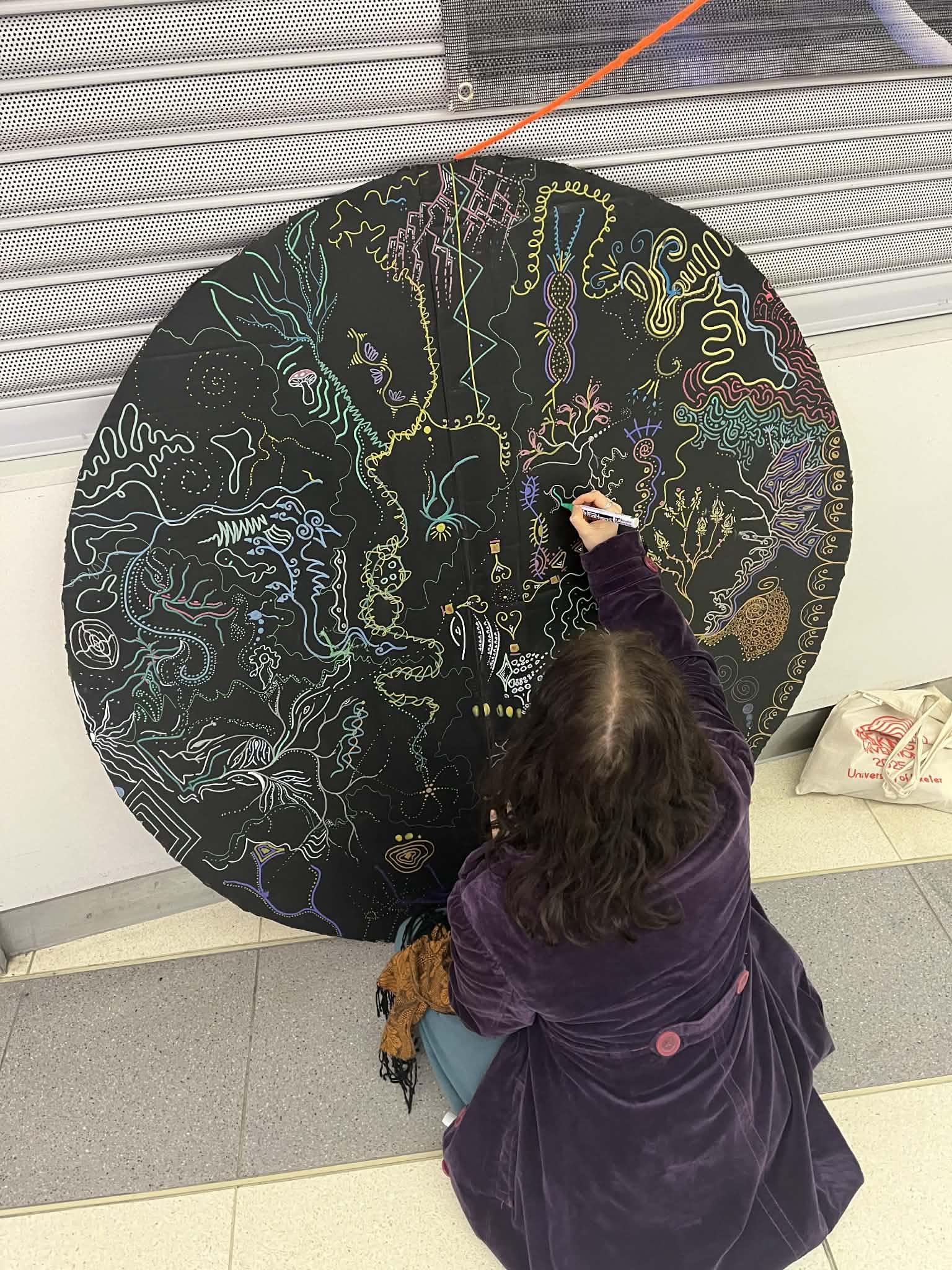
I was pleasantly surprised by the quality of the after party programming. Music is not exactly the priority of intellectual mixers, but for such dense subject matter, the decompressive joy of a dancefloor is always welcome. Both rooms delivered intricate, arresting dance music on the Saturday night to close Breaking Convention. Everything threaded together, much as Ros Stone’s installation of co-created knotted aphorisms did throughout the main hall — along with exquisite psychedelic art that went far beyond the cliché of Alex Grey imitators.
Breaking Convention 2025 was a journey through fascinating scientific, anthropological, sociological, political, and historical findings. It also plumbed the musical and visual arts for immersive relief from the intensity of conferences. The breadth of this field, including a cameo from QRI’s collaboration with ALIUS researchers, suggests the multimodality of transdisciplinary sciences provide a natural nexus for multifaceted learning. It further encourages that this breadth and depth is housed in such an idyllic part of England, with such global presence attending. Bridging epistemic and social worlds so effectively is an inspiration to planning such conferences in future.
Interviews
The following interviews are lightly edited for clarity and grammar with all the talking points and specific references preserved. (Note: any interviewees are free to contact us to revise these distillations if they so wish.)
One of the purposes of my attending BC this year was to put QRI’s work in dialogue with diverse transdisciplinary expertise (which is often what I do in my day job at the Odyssean Institute with expert elicitations through horizon scanning).
I went overboard with identifying as many intriguing interviews with intersections with QRI’s research. I was later informed this was by far the largest interviewing effort undertaken by the press this year! Here’s to someone beating me next time, as this contributed to the length of write up being considerable. I feel however that the extra time and effort was well worth it, as these interviews cover extensive findings, insights, informed and expert opinion, and academic and industry fields.
Maria Balaet
[Editorial note: Giuseppe shared some context on QRI’s research interests ahead of this exchange, though the framing may not have fully captured the specifics of Andrés’ position on medicalisation and cognitive enhancement.]
On the medicalisation question: I am all in favour of people using psychedelics for mental health improvements; but not in favour of dismissing all other use as ‘illegitimate’, nor am I in favour of stripping away personal freedom in regards to consciousness alteration and exploration insofar as the use does not harm others. I do have a worry that pushing for a medicalised model, while benefiting some, for sure, would inadvertently enforce the idea that it requires the approval of a body of authority for use of a drug to be legitimate. A world where an individual who can afford a very expensive psychedelic treatment is okay, but another growing their own mushrooms for the same or different reason isn’t — this is actually not that far off from the current situation. All that changes are the labels and the openness in the language used to characterise those cases.
On cognition: I think there is scope to explore potential enhancements from psychedelics. What I find particularly interesting is that while core cognitive functions are impaired acutely and sub-acutely, others — such as emotional recognition, use of metaphors, language, fluid thinking, insight and creativity — show potential for enhancement. The QRI competition experiment sounds really cool. The whole concept needs a follow-up study. I’d be interested in the dose-dependency and trip-timepoint at which those decodings may occur, and on a more technical point, how on earth does the light reflect to make it possible. Anecdotally, this is not the first time I hear of this idea. Over a decade ago I was at a festival where someone was trying to do the reverse — draw over the visuals to have a ‘record’ of the mandala-like features for when they turned sober.
Are there any related cognitive performance studies you’d like to see?
I believe our team has carried out the largest investigation of how cognition is altered by distinct naturalistic drug use patterns to date. We are due to submit our cross-sectional paper for publication. I would for sure be interested in employing a similar digital cognitive testing methodology, but this time in a prospective longitudinal design incorporating additional measures such as neuroimaging and wearable data. I am actively looking for funding opportunities to extend the depth of our findings.
How do psychedelics fragment attention, allowing for parallelism that might boost performance?
I think we first ought to make a distinction between what fragmenting attention means technically — the ability to process multiple threads at once — and what individuals would report during an experience. I am not sure whether this is a good thing for enhancing performance. Imagine attention as a string. In a parallel processing model you do not have one string split in four that then comes back together. Rather, you have four separate strings that you have hopes will intertwine to make novel strings. I am skeptical this boosts performance, and would point out the striking similarity to paranoia and even psychosis this has on a thought-process level. The way I see the potential of psychedelics to enhance performance is through a state of flow built alongside one string of thought.
[From a follow-up call:] On naturalistic drug use studies: virtually no such thing as people who use psychedelics and don’t also generally use cannabis. Polydrug effects are almost certain and rarely accounted for. (Giuseppe suggested an experimental design where participants were chosen based on extended abstinence, but with a prior history of experience, to potentially mitigate the challenge of avoiding the risk of testing effects on drug naive participants, or confounding results by using frequent users. This is because historic users differ in negligible ways from naive ones, preserving their experimental potential without exposing them to ontological shock as much. Maria found this highly interesting, so perhaps future work can benefit!) The cognitive fingerprint of drug use has an interesting facet: if you look at drug use across a lifetime, there is a relatively strong association; not only p-value significant but with notable effect size, with higher performance in language tasks. ‘You win some, you lose them.’ Maria would be interested in the Odyssean Process (my organisation’s flagship integration of expert delineation, with possible future modelling for decision aiding, to support citizen assemblies to deploy collective intelligence on the grand challenges we face) for future consensus work, and remains deeply interested in drug use as a human right.
David Luke
[Editorial note: Giuseppe had shared QRI’s frameworks on psychedelic phenomenology — including the distinction between semantic content and phenomenal character — with David ahead of the exchange, though isn’t entirely certain how fully this context landed before the reply was drafted.]
How do you distinguish between semantic content (the meaning or narrative of the trip) and phenomenal character (the texture of the state)?
This obviously needs exploring in more detail. My interest in the seemingly hyperbolic and extra-dimensional aspects of psychedelic experiences (especially DMT) was much more heuristic, in that I hoped to draw attention to something that deserved deeper research and should not be ignored. I began by trawling Erowid trip reports for such accounts and found them to be numerous, though of course they have not been parsed for semantic versus phenomenal content. I salute Andrés’ systematic approach to apparently hyperbolic and extra-dimensional form constants.
What kinds of measures do you use when probing this?
Currently I am not pursuing it. I had hoped to use some VR hyperbolic maze simulations to see if having had such experiences could result in some kind of behavioural outcome, but while finding hyperbolic VR mazes is feasible, finding higher dimensional ones has been a challenge — though a friend says he’s finally cracked it, and I’ve not seen it yet. I have seen some of QRI’s work on hyperbolic geometry, but not recent developments.
Could lower-level phenomenal descriptions — flicker frequency, spatial frequency, cross-frequency coupling — reveal processing capacities above and beyond the narrativised account?
[Editorial note: The question as put to David drew on QRI’s specific psychophysics vocabulary. Giuseppe relayed this but notes the original framing may have been more technical than what came through in the exchange.]
I think finding some neurocognitive mathematical marker such as this would be very worthwhile mapping to psychological indices. There is much to be done, and so much we still do not know. My thinking on this about fifteen years ago suggested this could pose an insight and be useful for testing. I’m glad the phenomena is being taken seriously and considered more now.
Simon Ruffell
Do you agree with Shinzen Young’s definition of suffering = pain x resistance? Is this helpful, or perhaps even cruel to tell people with serious pain something like this? Perhaps comment broadly on your work and findings in relation to alleviating extreme pain e.g. cluster headaches?
On Shinzen Young’s formulation of suffering as ‘pain × resistance’: I do broadly agree with it — it resonates with many contemplative and therapeutic frameworks that recognise how resistance, whether cognitive, emotional, or physical, can amplify distress. That said, for individuals experiencing chronic or extreme pain where there’s no immediate resolution, such a statement can sometimes feel invalidating if delivered out of context. So much depends on how these ideas are introduced, and whether the person has the resources to explore them meaningfully.
In terms of our work, we don’t often see participants presenting primarily with chronic pain, so we don’t have direct data on this. I do vaguely recall a small handful of cases where people reported significant improvements in symptoms such as cluster headaches or fibromyalgia following retreat work — anecdotal, not studied systematically, but they’ve stuck with me due to the intensity of the reported change. I’d be very interested in QRI’s work in this space, particularly if there are opportunities for collaboration.
Rayyan Zaffar
[Editorial note: Giuseppe provided some context on QRI’s interest in translational neuroscience and consciousness biomarkers prior to this exchange.]
What is the cutting edge of psychedelics for addiction and dependence?
In psychiatry, neuroscientific brain imaging on addiction has generated up to 450 studies with various biomarkers — and yet problems with cognitive and memory systems as biomarkers have not translated into effective therapeutics. Despite knowing about endorphins and dopamine, there hasn’t been great innovation in pharmaceuticals to treat addiction. The reframe needed is to direct a meaningful slice of funding toward translational biomarker infrastructure: employ multimodal brain imaging across four or five systems — dopaminergic, opioid, GABA-glutamate, and endocannabinoid — set up experimental medicine hubs attached to universities and pharmaceutical companies, and pump out investigation to generate targeted therapeutics.
Do you have a vision for a research program if you had e.g. $1 billion?
Prevention and early intervention is also needed beyond biopharmaceutical efforts: resilience building in curricula, engaging underserved groups, piloting community healing centres. We need to develop reach for therapists in the workforce — training a multidisciplinary psychedelic therapist workforce prepared in care, ethics, neuroscience, and infrastructure for rehab facilities or inpatient wards.
What kind of interventions are likely to be used in 10 years from now to treat opiate dependence, benzodiazepines etc. dependence broadly all relevant.
Precision psychiatry allows us to match treatment to digital phenotyping and genetics, reducing the time to effective treatment. Right now it takes seven to ten years to zero in on treatment for addiction. Even halving this would make a huge difference to public health. We still don’t know how many of these mechanisms of action work; we have not deployed translational analysis to these treatments sufficiently yet.
On consciousness biomarkers specifically: emerging consciousness research — how does brain synchronisation or activity change in the midst of experience, and how does it re-emerge electrophysiologically — tells us the basis of what we perceive as reality. There is a natural analogy with QRI’s frameworks here that Rayyan found genuinely interesting.
Erik Davis
In what way do psychedelics — more so than causing belief — break down beliefs or crises of faith?
While psychedelics could function in some traditional contexts to maintain belief or at least enforce cultural continuity, in the modern postwar arena they have often been understood and experienced as something like ‘de-conditioning agents.’ Acid could really act like an acid in terms of dissolving fixed structures, getting down to the core ontological categories of space, time, causality, identity. This meant that deep psychedelic experience often had a profound existential dimension of deep questioning, ontological confusion, and nihilism — sometimes funny, sometimes not. In today’s more healing-oriented frameworks, this deconstructive and deconditioning power has been sidelined — even ignored — as part of a clear preference for new beliefs and motivating structures. This is unfortunate, as it both undermines the liberating side of psychedelic de-conditioning and ignores the real dangers of trying to integrate profound dissolution and ontological breakdown.
The messaging of psychedelics ‘revealing the divine’ implies they push us in the same direction — but many have reported the opposite, with belief systems broken rather than confirmed.
It seems like any set of tightly held assumptions can find themselves on the altar of deconstruction. That said, there are modes of the sacred that exist alongside and even dependent upon ontological breakdown. There is something like an ‘existential spirituality’ that is part of psychedelic culture — it looks very different from mainline Christianity. The humorous or prankster approach to psychedelic mysticism — like Discordianism — has space for both deconstruction and the emergence of sacred surprise.
Can cultural priming or egregores construct or deconstruct belief?
I am not sure that psychedelic culture is ready to take on the consequences of priming and the ‘programming’ of trips. These factors were well recognised in the ‘60s — Leary and Lilly both talked about programming and meta-programming — but we seem largely interested in relying on less contingent frameworks, ones where there is a coherent wisdom coming ’from the jungle.’ The looping effect is vertiginous and probably maddening for some, and yet it seems to characterise a good deal of the situation. But not all — the different substances themselves are different however much their related experiences are ‘constructed’, and that difference points towards a level of agency and reality-making beyond cultural priming alone.
Peter Sjöstedt-Hughes
Philadelic Presentation talked about how hallucinations being internal or external is a false dichotomy, or direct perception vs not. You said that some things will be one or the other: what would it mean for our spirits on LSD becoming One, but our visual fields remain separate?
How is this compatible with the transitivity of sensations; how can we have partially inside and partially outside awareness? Do these break deep rules of logic, or require dialetheism to explain?
How best to make sense of these mixed states of perception?
How does Whitehead’s process ontology perhaps bridge this?
In early twentieth century Anglophone philosophy, there arose a debate between Representationalism and Realism. Whitehead’s Process and Reality was written as a more realist version of Bradley’s metaphysics. For Whitehead, perception involves more primally a process he calls ‘prehension’: the ‘object’ flowing into and constituting the ‘subject’ (both themselves being processes). Prehension is akin to Bergson’s specific notion of ‘sympathy’. Under this framework, perception of the ‘external’ world is absorption — which differs in kind from the representations in dreams. This is Realism in this sense: direct acquaintance with the outside world, the effacing of the inner/outer dichotomy. The place to look is firstly the context of Representationalism vs Realism, then Whitehead’s specific notion of ‘prehension’.
Do you have an intuition for what pleasure and pain are, and if ‘spiritual’ pain is qualitatively different from physical?
I don’t really have anything relevant to say about pleasure and pain in this respect, only that in Whitehead’s thought, intensity of experience is the highest value.
Pascal Michael
[Editorial note: The following is a condensed version of a detailed written response on phenomenological discrimination between NDEs, psychedelic experiences, and UAP/abduction accounts.]
Is there something specific that differentiates NHI/UFO phenomena markedly from other altered states?
Surveys that can distinguish between states of consciousness are very interesting to QRI. Andrés is developing a survey for people who may take a ‘mystery drug’ and ask you to rate images by how similar they look to the hallucinations you’ve experienced. The assumption is we can then guess better than random, by using phenomenology as a diagnosis tool.
Very curious about a 10-20 question quiz on phenomenology and what to look for between NDEs, NHIs, or drugs? What most cleanly separates these categories?
Cleanly separating NDEs, UAP/abduction and psychedelic experiences requires considering features that load preferentially onto each category. For NDEs: a ‘return’ or ‘sent back’ structure; encounters with deceased relatives; autoscopic OBEs; the tunnel phenomenon as a dark space with a single expanding circle of light; and life review. There is also a more narrativistic, story-like character versus the other two categories.
For DMT specifically: rapid onset with abrupt landing; high-density visual patterning and hyperdimensional environments; entity encounter typology dramatically skewed toward unfamiliar or otherworldly beings rather than known deceased individuals.
For UAP/abduction: important phenomenological similarity with hypnagogia and sleep paralysis, though numerable accounts transpire spontaneously under normal wakeful states, especially witnessing UAP, which may only subsequently lead to an ASC-type state. The lack of any precipitating context makes these accounts particularly enigmatic.
Overall: structural motifs can overlap strongly across all three (disembodiment, light, tunnel, entities, other worlds) while the frequencies and, more importantly, the specific expressions of each diverge sharply. I think that context remains the most critical distinguishing factor. A questionnaire with these features as subscales could allow experiences to be classed as Single-class (one score clearly dominant), Hybrid-class, or Ambiguous.