Create the world’s most accurate visual representations of the jhana states. Prizes for each individual jhana plus a grand prize for best overall contribution.
Contemplative traditions have described the jhanas (states of deep meditative absorption) in text for over two thousand years. The science of consciousness is starting to look at them in the lab. But we still lack a clear visual language for communicating the rich and layered qualities of experience involved in each jhana aka. their phenomenal character. We want to change that.
We’re inviting artists, meditators, technologists, and anyone who has glimpsed these states to help us build the world’s first rigorous visual atlas of the jhanas.
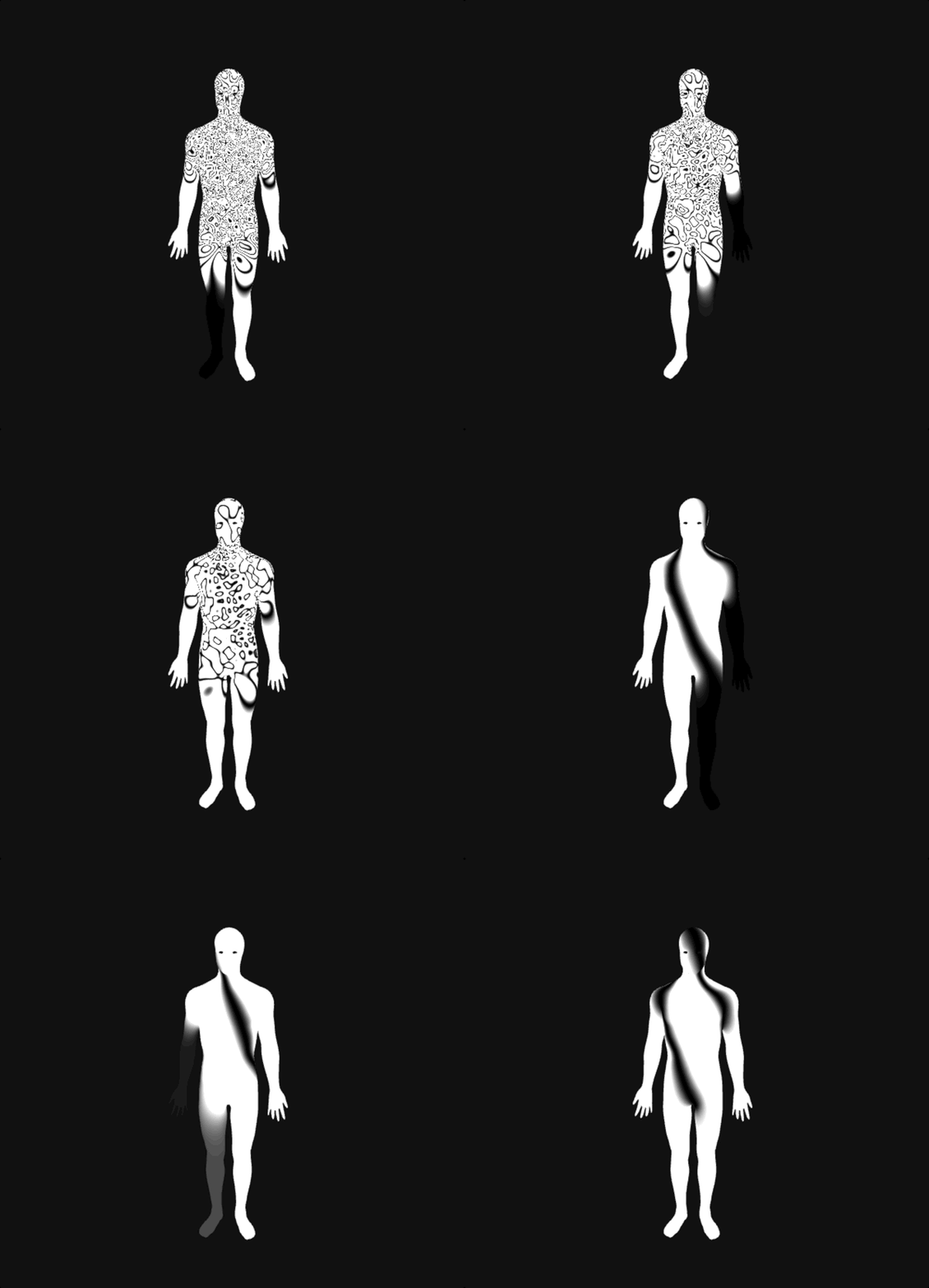
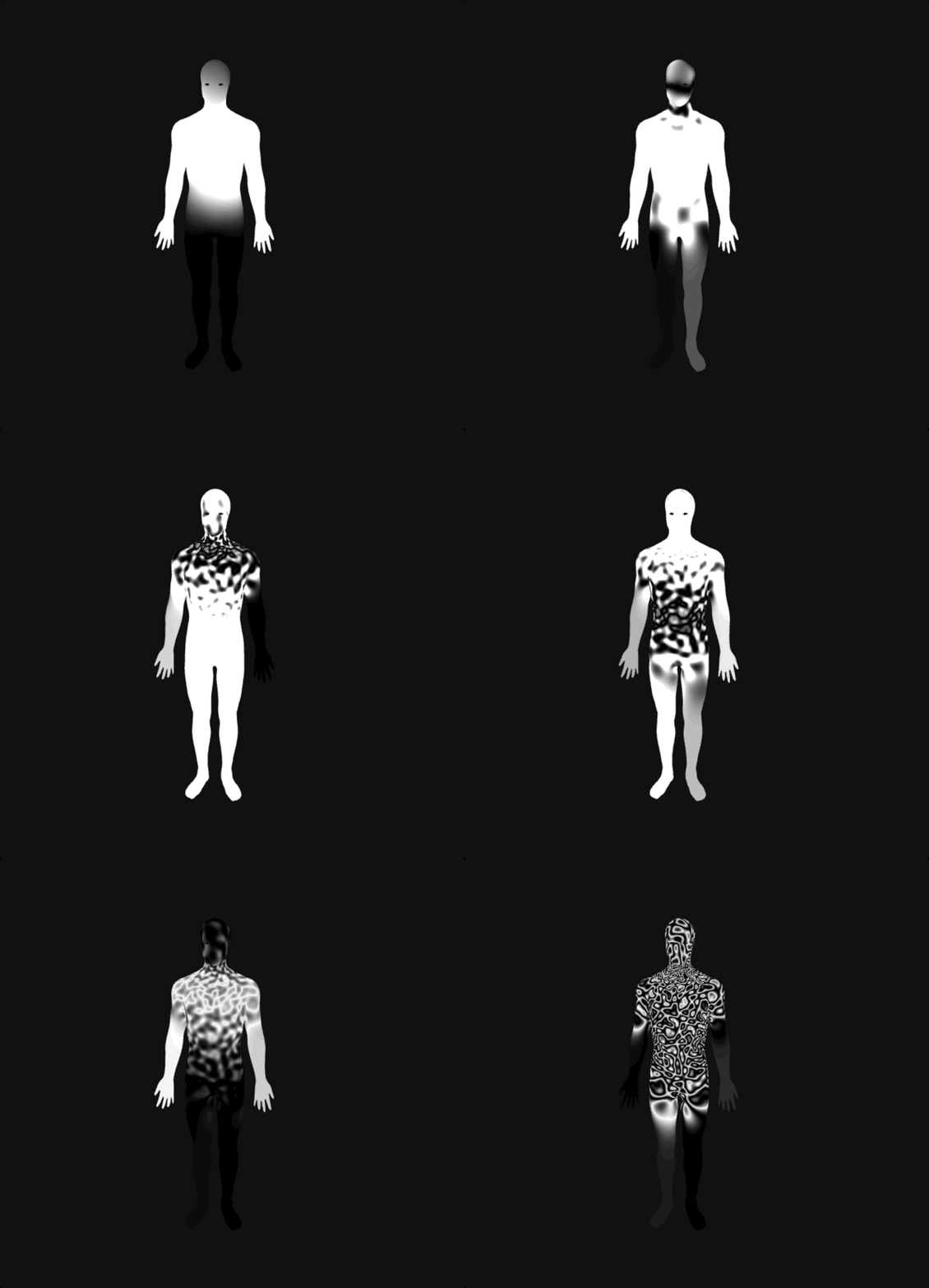

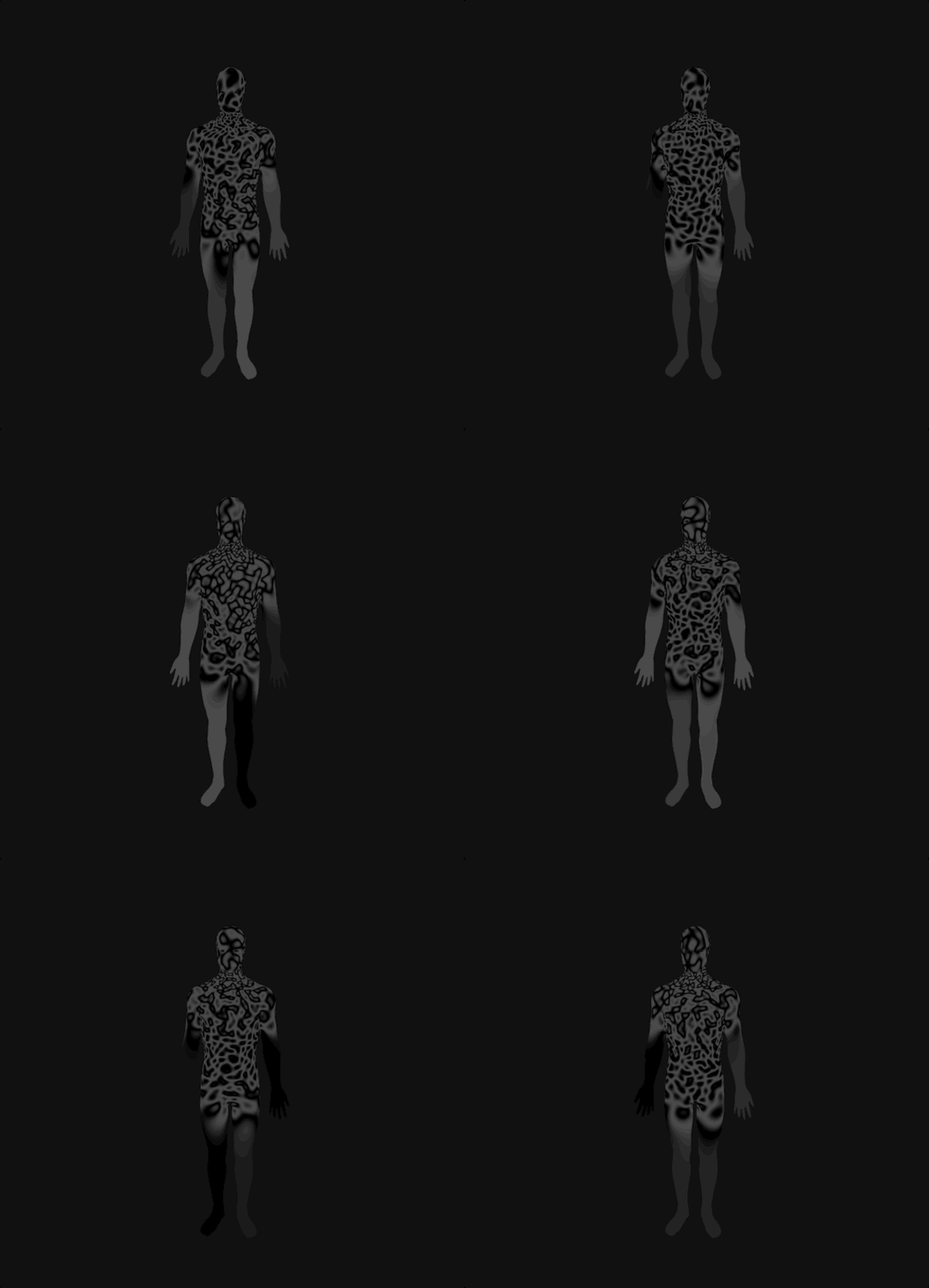
The Challenge
Create a video that captures what it is actually like to be in a jhana state.
You may submit up to three videos (MP4/MOV up to 2 minutes each), each depicting as many jhanas as you wish. We will award 9 prizes in total: one for the best visualization of each of the 8 jhanas, and one for best overall contribution.
Each submission should be tagged with the jhanas it depicts, on a second-by-second basis. For example, a video exclusively depicting jhana 1 can simply be tagged “jhana 1.” A video covering jhanas 1 through 3 in sequence should be tagged: “jhana 1 (0:00–0:50), jhana 2 (0:50–1:12), jhana 3 (1:12–1:58).” Each tagged segment will be entered automatically into the corresponding individual jhana prize competition, and the submission as a whole will be considered for the overall contribution prize.
In principle, a single video could win all 9 prizes. Judges will evaluate each jhana segment on its own merits — a weak depiction of one jhana will not penalize the depictions of others, as long as segments are properly tagged. The overall contribution prize will also take into account the quality of transitions between jhanas.
To become acquainted with the kind of phenomenal replications we have explored, see the contest announcement for a previous visual replication competition (for psychedelic rather than meditation phenomenology), and the replication contest results for reference.
What Are the Jhanas?
The jhanas are a sequence of states of deep meditative absorption described across Buddhist and other contemplative traditions for over two thousand years. Each state is characterized by a distinctive phenomenal texture — a particular quality of attention, pleasure, and awareness — and the sequence progresses from highly concentrated, rapturous states (J1–J4) through increasingly rarefied "formless" absorptions (J5–J8) in which distinctions of body and space, self and time, gradually dissolve.
Whether the jhanas have a unique, signature phenomenal character (meaning, a hard "essence" in terms of structured tactile, kinesthetic, and visual sensations we could point at) or whether they are better understood as simply sharing a loose family resemblance of related absorption qualities, remains an open question. Interest in settling it has grown significantly in recent years: can we capture the core features of each jhana in a crisp and undeniable way?
Discussion about the nature of the jhanas has recently spread well beyond traditional Buddhist communities: ACX posts (see also: 1, 2), Jhourney retreats, and TPOT have been new venues for debate, against a background of practitioners working through Daniel Ingram's Mastering the Core Teachings of the Buddha, Shinzen Young's systematic frameworks, Michael Taft's guided meditation recordings, and Rob Burbea's Practising the Jhanas talk series. We believe that this recent influx of technically-oriented, rationalist-adjacent practitioners makes this a great time to run this contest.
For a secular orientation to the phenomenology of jhanas, we recommend digging into several dharma teachers rather than any single one, as the texture of jhana can vary significantly by method and mode of exposition. Two of the most practical Western references are Leigh Brasington's Right Concentration: A Practical Guide to the Jhanas (a sutta-based, practitioner-oriented demystification of the jhanas as the Buddha's own specification of Right Concentration) and Stephen Snyder & Tina Rasmussen's Practicing the Jhanas, which presents the Pa Auk Sayadaw method from authors who completed all eight jhanas under his guidance. In his later work and interviews, Snyder emphasizes a non-dual reading in which deep jhana absorption and a direct sense of oneness with the Absolute are not separate attainments but aspects of the same dissolution of the separate self. Above all, we want participants who are convinced there is a 'there there' to these states and are motivated to depict it.
The table below gives a simple working approximation of the phenomenal character of each jhana, which serves as a non-denominational secular reference for this competition.
Prize Structure
Individual Jhana Prizes (~$500 for each jhana, and $1K for the “overall contribution”)
One prize for the best visualization of jhana (as listed above).
| Prize | State | Phenomenal Texture (to a first approximation) |
|---|---|---|
| J1 | First Jhana | Attention latches. Applied and sustained attention. Rapturous vibration. |
| J2 | Second Jhana | Effort drops. Joy without exertion. Internal confidence. |
| J3 | Third Jhana | Contentment without grasping. Body placidity and peace. Cool pleasure. |
| J4 | Fourth Jhana | Equanimity. No resistance. Uniformity of attention and awareness. Non-grasping. |
| J5 | Fifth Jhana (Infinite Space) | Boundless spatial openness. Sense of barrierlessness. Figure-ground inversion for space vs. object. |
| J6 | Sixth Jhana (Infinite Consciousness) | Knowing the knower. Reflexive awareness. |
| J7 | Seventh Jhana (Nothingness) | Nothing to grasp. Not landing anywhere. |
| J8 | Eighth Jhana (Neither Perception nor Non-Perception) | The thinnest possible subject/object/time triad. |
Prior work worth looking at as reference material: Roger Thisdell's visualization of the 8 jhanas, Visualizing Tactile Sensations (Volpato R., Gomez-Emilsson, A., Kuntz E., Martinez Quintero, C., 2023).
Best Overall Prize (~$1,000)
Best Overall Contribution (~$1,000), awarded to the single submission that represents the most significant contribution to the visual phenomenology of jhana. Each submission is evaluated independently for this prize — a participant’s other submissions are not taken into account. The overall contribution prize also rewards the quality of transitions between jhanas, not just the individual jhana depictions.
Bonus Categories (honorable mentions, no cash prize)
Best Transition Sequence. We would love to see what the transition between states actually looks like — for example, a submission moving from jhana 1 through jhana 3 in sequence. Transition-focused submissions compete for the overall contribution prize and for any individual jhana prizes corresponding to their tagged segments, but the transition sequences themselves will also be recognized with a dedicated honorable mention.
Best Jhana Induction Aid. This category is not about accurate replication but about utility: a music video or guided visual that plausibly boosts a meditator’s chances of accessing a state. Recognized with an honorable mention.
What We’re Judging
The visualization accounts for roughly 75% of the score. The remaining 25% is your written description: how you made it and what effects you used.
Inspired by what we have learned from previous competitions (technical replications contest) we will be paying attention to the following aspects of phenomenology in the submissions:
Phenomenal Character Over Semantic Content
We focus on the phenomenal character rather than semantic content. We don’t mind what visualization techniques the person is utilizing or what they point at. E.g. whether they use a candle flame or a little heart as the depicted object of concentration. What we care about is how the submission represents and conveys the “what it is like” of the state rather than the “what it is about” of it.
Methodological Context
Jhana texture varies significantly by induction method. Rob Burbea's Practising the Jhanas, for instance, describes three broad approaches: (1) focusing on the breath and excluding all other sensation, (2) first stabilizing loving-kindness in the body, then shifting attention to the arising pīti and sukha, and (3) actively spreading and saturating the body with pleasant sensations. Each route can produce genuine absorption, but the phenomenal character of the result differs. For this competition, no method is considered more correct than another — we only ask that you briefly describe the approach you used, so judges understand what jhana texture you are aiming for.
Attention and Awareness Dynamics
What the attention is doing and ways of engaging with it so that it facilitates meditation. In other words, visualize in a way that it helps others in discovering the inner moves behind these states. In some sense, an accurate depiction of jhanas is implicitly an accurate depiction of attention and awareness dynamics as well. Perhaps the jhanas might be like a microscope to study how the quality of attention constructs our experience of the world.
Frequency, Coupling, and Synchronization
Try to get the frequency dynamics, coupling dynamics, phase coherence and synchronization, cross-frequency coupling right. Generally speaking, any kind of color-coding for different sensations, types of sensations, etc. can help you. This way we would know “in this visualization a point of red, for example, maybe symbolizes the qualia of warmth in tactile sensation”.
For those taking the technical route, if you’re familiar with QRI’s Oscilleditor or coupling kernel paradigm, this is your playground. How can you translate a jhana in terms of attractors of systems of coupled oscillators? We think this is a very strong (though not the only) approach to this contest.
Labeling and Documentation (25% of Total Score)
In addition to a visualization, participants will need to submit a 200-1,000 word explanation for each of the submissions. The text should explain how the visualization was made and how to interpret it as a depiction of the phenomenology of jhanas. For example, if colors have a special meaning, please state this in this text. The text should also explain how the jhana depicted was experienced (e.g. details about the meditation practice that led to it are welcomed and encouraged).
Body Representation (Required for J1–J4)
The first four jhanas should have an avatar, whether it’s 3D or 2D or even schematic or cartoon-like. But it is important for there to be a reference for the body in the visualization.
Energy Body and Internal Volume
We encourage you to go beyond the skin surface. For example, we believe there is benefit in depicting what Rob Burbea calls "the energy body". That is, the sense of a cocoon of sensation surrounding and interpenetrating the physical body, which is often more prominent than the standard sense of the body during meditation. Play with the volume and anatomical features of the body in 3D. Prioritize conveying the feeling of the state over spatial accuracy of sensations.
Creativity in Depicting Formless Jhanas (J5–J8)
For the formless jhanas, extreme creativity is encouraged and welcomed. The constraint that J1–J4 must include an avatar does not apply here. These states push beyond embodied experience (or do they?), and we want submissions that push beyond conventional visualization ideas. What does the flow of attention look like when you’re “embodying the sense of boundless space”? We think there are clever answers here.
Practical Usefulness
One of the minor but important aspects of the scoring will be based on these two questions: Could you use it for meditation? Could you use it to mirror your practice?
Submission Format
Each submission should include:
- The Visualization. Video (MP4/MOV, up to 2 minutes).
- A Written Description (200–1,000 words) What each visual element represents. Which features of the phenomenology you prioritized. What model of the body, mind, and attention you used. How you achieved the effects. Do specific colors mean anything?
- Jhana Designation: divide the block of time into segments and tag each of them with the jhana being depicted. Example: “jhana 1 (0:00-0:50), jhana 2 (0:50-1:12), jhana 3 (1:12-1:58)”.
You may submit up to 3 entries. A single artist can win multiple individual prizes and the Overall Prize.
Submission Deadline
June 4th, 2026, 10PM Pacific Time. Submit your entry here.
Judging
Submissions will be evaluated at the QRI Consciousness Research Retreat in Mexico in early June 2026, immediately following the conclusion of the 10-day formless jhana retreat component. The judges will primarily consist of people emerging fresh from that retreat, with recent direct acquaintance with the phenomenon at hand.
The panel of judges will consist of:
- Attained meditators with established jhana access, rating phenomenal accuracy from direct experience
- QRI researchers evaluating the technical and mathematical rigor of parametric models
- Artists and VJs assessing aesthetic quality and technical innovation
Publication and Social Networks
All submissions will be published by default — please indicate upon submission if you wish to opt out. We strongly encourage publication: this is how we build a shared visual language for consciousness.
Technical Resources
Tools You Might Find Useful
- QRI Oscilleditor. Design coupling kernels on a log-polar lattice.
- Tracer Replication Tool. Reference for the phenomenal replication standard we use.
- Coupling Kernels and Consciousness. The theoretical framework behind our parametric approach.
- WebGPU / GLSL / Three.js / TouchDesigner / Blender. ShaderKit. All welcome.
Prior Art
See the Replication Contest results for the aesthetic of our research and approach to judging technical phenomenology replications. The jhana contest will use many of the same principles but extend them from psychedelic phenomenology to meditative phenomenology.
Why This Matters
The jhanas are among the most reproducible and well-documented altered states of consciousness associated with intense wellbeing. Meditators report strikingly similar phenomenal progressions across traditions, spanning a wide range of pleasurable qualities. And yet, we have almost no visual record of what these states look like from the inside. As part of the broader mission of mapping the state-space of consciousness, the contest will help us build an Atlas of jhana states.
Our bet is that there is something between family resemblance and a hard essence that unites these states of absorption. It is not a simple criterion that makes the classification easy, but it is also not a mere collection of features without a hard boundary so that two jhana 1 states could be entirely dissimilar yet belong to the same class (as with maximum differences between members of a family resemblance class). Rather, while texture and presentation can vary significantly, we suspect something in the vicinity of "overall phase coherence, cross-frequency coupling, and linear wave behavior" come together to define e.g. jhana 1. One can even anticipate from first principles that if overall phase coherence increases as we go up the jhanas, then the diversity of manifestations of these states shrinks as well. There are many ways for a system to be 60% coherent, but there aren't that many ways for it to be 99.99% coherent. So while we can expect a lot of diversity in the submissions, we also anticipate that an essential quality will emerge as defining of each jhana.
Creating a visual jhana Atlas opens a range of interesting options, as we can:
- Give practitioners better maps for navigating their own practice and discovering inner moves
- Give researchers a common reference frame for empirical work on meditative states
- Discover structural regularities across individual reports that text descriptions can’t show
- Test mathematical models (Kuramoto dynamics, coupling kernels, topological charge) against lived experience
Each submission is important, and ultimately the prize is just a way to motivate the community to contribute to this effort. We thank you for your consideration and we are eager to see what you have to share!
Eligibility
The contest is open worldwide to individuals aged 18 or older, except where prohibited by law or U.S. economic sanctions. Employees, officers, and directors of QRI and their immediate family members are not eligible. No purchase is necessary to enter or win. See full contest rules for details.
Intellectual Property Rights
Artists retain full ownership of their submitted work. By entering, you grant QRI a non-exclusive, perpetual, royalty-free license to publish your submission on QRI’s website, in research publications, and in promotional materials for QRI and the contest, with proper attribution and links to the artist’s work. You are free to use, sell, license, and exhibit your work elsewhere. This contest-specific license controls over the broader license in QRI’s general contest rules, as provided for in those rules.
Submissions must be your original work. If your video incorporates third-party material (music, footage, etc.), you must have the rights or license to use it.
Tax Information
Winners are responsible for all applicable taxes on prize income. U.S. winners whose cumulative prizes total $2,000 or more must provide a completed IRS Form W-9 before prizes are awarded; Sponsor will issue IRS Form 1099-MISC. International (non-U.S.) winners are subject to 30% U.S. federal tax withholding and must submit IRS Form W-8BEN before prizes are awarded, unless a tax treaty applies. See full contest rules for details.
Winner Announcement
Winners will be announced by June 30, 2026 on the QRI website and notified by email. If a winner cannot be contacted within 14 days of notification, the prize may be forfeited and awarded to an alternate winner.
Questions?
Reach us at hello@qri.org or on Twitter/X at @QualiaRI.
Infinite bliss!
The contest and donation sections below are independent. Making a donation does not improve your chances of winning.
Support QRI
As a token of appreciation for your support, explore QRI's Magical Creatures line of phenomenal scents.






Acknowledgements
We would like to thank the participants and winners of our previous Consciousness Art Contests for establishing the standard of phenomenal replication that this competition builds upon. Thank you to QRI’s donors for making this work possible.